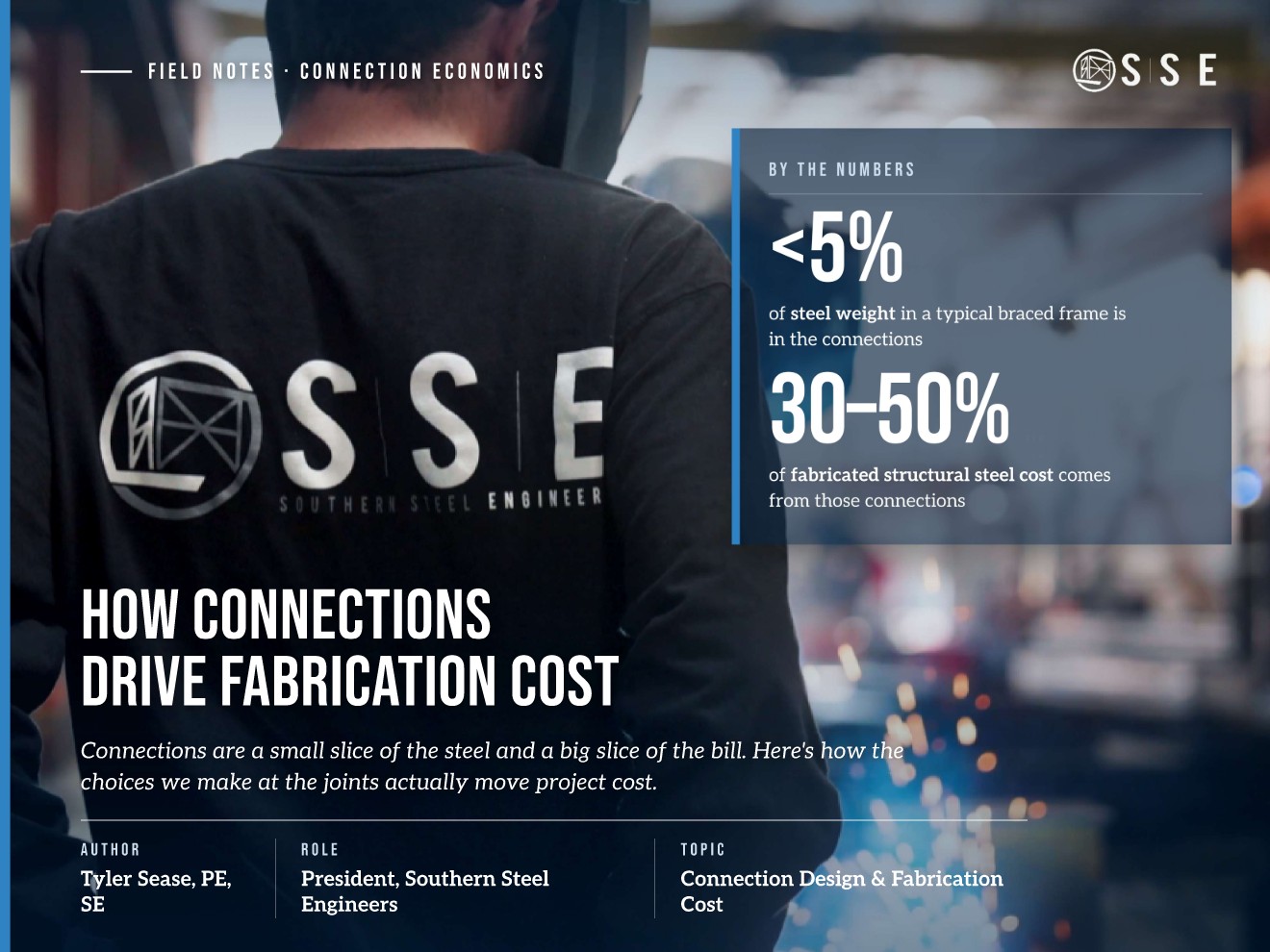
Connections typically drive 30 to 50 percent of total fabrication cost on a structural steel project, even though they account for less than 5 percent of the tonnage in a typical steel building. Combined with the fact that fabrication and erection make up roughly 70 percent of a steel package's cost (material is less than a third), the engineering choices made at the connections drive an outsized share of what a project actually costs to build. This article walks through how those choices translate to cost on the shop floor, and what cost-conscious connection design looks like in current practice.
The cost figures are well documented and consistent across sources. The Steel Construction Institute, in its guidance on simple connections, reports that connection fabrication can run 30 to 50 percent of total fabrication cost. AISC's construction cost guidance is direct on the broader picture:
"Most of the steel package's cost comes from fabrication and erection."
— AISC, Construction Costs guidance
That cost is split: fabrication and erection together typically run 70 percent or more of the steel package, with material accounting for less than a third. Pull those facts together with the SCI data and the implication is clear: the connection-driven labor on a steel project is roughly 20 to 35 percent of the entire steel package cost.
That share is not just labor sunk into the connection itself. Connection complexity drives setup time, fit-up time, weld inspection, handling and marking on the shop floor, sequence-driven detailing, and erection difficulty. A connection that looks like a small detail on a drawing can carry hours of compounded work behind it.
The classic AISC reference on this subject is David Ricker's Engineering Value into Your Project, updated by Charlie Carter and republished in Modern Steel Construction in October 2007. The article is older than most engineers would guess, and the spirit of its recommendations still holds. Ricker put the principle bluntly:
"Do not design for minimum weight alone."
— David T. Ricker, P.E., Modern Steel Construction, October 2007
The argument behind that line is that material savings on lighter members are routinely consumed by additional connections, additional shop work, and additional field erection. Ricker also gave the industry a set of cost equivalents that are still useful to think with today. Stated in pounds of equivalent A992 steel:
Those numbers are conceptual, not contractual, but they make the point. The "saved" steel from chasing a lighter beam can be paid back several times over when that lighter beam drives stiffeners, doublers, or a more complicated splice. Current AISC guidance reinforces the same recommendation: consider eliminating doubler and stiffener plates by using a heavier column instead. For a deeper treatment of the stiffening question, the relevant reference is AISC Design Guide 13: Wide-Flange Column Stiffening at Moment Connections.
The single most consequential weld decision an engineer makes is fillet weld size. Ricker put it directly: keep fillet welds to a maximum of 5/16" so they can be made in a single pass.
That recommendation is not arbitrary. A 5/16" fillet is generally a single-pass weld. A 3/8" fillet typically requires three passes, with interpass cleaning between them. That is roughly three times the arc time on every inch of weld, plus the cleaning, plus more inspection length, plus more chance of porosity or slag inclusions to repair. A small spec change drives a large floor-time multiplier.
The cost ladder of weld types runs the same way. Fillet welds are the cheapest weld a shop can make. Partial-joint-penetration (PJP) welds add joint preparation. Complete-joint-penetration (CJP) welds add more preparation, more weld volume, more heat input, more distortion control, and ultrasonic or radiographic inspection. The default behavior for cost-conscious connection design is fillet first, PJP only when geometry or load demands it, and CJP only when the connection genuinely requires the full strength of the joining material.
A practical implication that often surprises engineers: a slightly heavier plate with a 5/16" fillet weld will frequently beat a thinner plate with a 3/8" fillet weld on total fabricated cost. The plate is cheap. The third pass is not.
Bolts as material are inexpensive. Bolts as labor are not. The cost of a bolted connection lives in hole preparation, handling, installation, and inspection, not in the bolt itself.
A few practical points:
These are the kinds of decisions that experienced delegated connection design engineers make connection by connection. They are also the kinds of decisions that move project cost meaningfully, even though no individual choice looks dramatic on its own.
A shop weld is almost always a better weld than a field weld. Position, environment, fit-up, lighting, inspection access, and the welder's posture all favor the shop. Field welding fights weather, access, overhead positions, and inspection coordination.
The cost gap is real, and recent industry data quantifies it. Christian Crosby, senior vice president of fabrication at Schuff Steel, presented these numbers at NASCC 2024 in a talk titled Connection Economy: Thoughts From a Steel Fabricator, reported in The Fabricator: field welding can run upward of 40 percent higher in cost than the same weld made in the shop, and field welding is on average 35 percent less efficient than shop welding by labor measure.
Those numbers should change how engineers draw connections. A bolted field connection drops into place and torques in minutes. A field CJP weld is a half-day affair plus non-destructive testing. Multiply that across a project with hundreds or thousands of beam ends, and the design instinct toward field welding starts to look expensive.
Where field welds are unavoidable, such as certain moment connections, some seismic details, or retrofits to existing structure, the engineering move is to make them as small as possible, as accessible as possible, and in the flat or horizontal position whenever the geometry allows. Out-of-position field welding is where projects bleed schedule, and where field fix engineering often gets called in to clean up details that should have been right the first time.
The same connection can be inexpensive in one shop and a labor sink in another. The difference is the equipment.
A modern structural steel fabricator running an automated CNC beam line (Peddinghaus, Voortman, Ficep, and similar) imports DSTV files directly from the detailer, drills standardized hole patterns at machine speed, and feeds beams through robotic copers and plasma cutters that handle complex cope geometry that would be expensive to do by hand. Robotic welding cells handle repeating fillet welds in standard positions. Layout and marking happen automatically.
A shop with less automation runs the same project differently. Holes might be drilled with a mag drill against a manual layout. Copes might be cut by hand. Welding might be entirely manual. Two shops bidding the same set of plans will have very different cost profiles before the first piece of steel arrives.
This is why connection design cannot be done from a desk in isolation. Crosby put it directly in the same NASCC talk:
"When the complexity rises, the shop labor costs increase as well."
— Christian Crosby, SVP of Fabrication, Schuff Steel; NASCC 2024
Fabricators know their own people and their own equipment, and the connection that is most efficient in one shop is often not the most efficient in another. Even an AISC-certified shop will not be efficient at fabricating a detail it does not regularly produce. The implication for the engineer is that the "obviously efficient" connection on paper can be the wrong choice for a particular shop.
We are built to serve fabricators precisely because connection design works best when it is tailored to the shop that will build it. The fabricator's input on equipment, sequence, and shop preference is data, not opinion.
Reading the AISC Manual is necessary. It is not sufficient.
The team at SSE has spent deliberate time on the fabrication shop floor, not just on tours but doing the work. Our engineers have welded, torqued TC bolts, run holes through beam webs, watched fitters lay out and tack assemblies, and observed how a beam moves from raw stock to a painted, marked, and shipped piece. We do this because the gap between "the connection works on paper" and "the connection runs efficiently through the shop" is a gap that closes only with hands on the steel.
We've captured some of this on video. Our team talks through what they take away from time on the fab shop floor:
That experience changes how we draw connections. It changes which weld access we worry about. It changes how we think about fit-up tolerances and sequence. It changes how we review shop drawings, because we have seen the file move from the model to the machine. It is one of the reasons our principal engineers, several of whom began their careers working for major steel fabricators, design connections that fabricators recognize as constructible on first read.
The principles above translate into a working set of design habits we apply on every project:
None of these habits is novel on its own. The combination of all of them, applied consistently across a project, is what separates connection design that supports a fabricator from connection design that creates work for one.
The math at the top of this article is worth coming back to. Connections drive roughly 20 to 35 percent of the total cost of a fabricated steel package. The engineering fee for delegated connection design is a small fraction of that. On most projects, the difference between two engineering proposals is small enough that it would be paid back many times over by a single well-chosen connection detail, or lost many times over by a poor one.
That is the case for choosing your connection engineer the same way you would choose any other partner whose decisions ripple through the project: on capability, on shop knowledge, and on whether they will design for the way your shop actually builds. Engineering fees are visible up front. The decisions made under those fees show up in the bid, in the schedule, in the shop, and sometimes in expensive field corrections on details that should have been right from the start.
At SSE we design steel connections on hundreds of projects every year, in close coordination with fabricators, detailers, and erectors. We support work in 46 states, and our team includes professional engineers, structural engineers, and a Certified Welding Inspector. If your next project includes connection design, reach out to us. This is where we thrive.
Connection fabrication typically accounts for 30 to 50 percent of total fabrication cost, even though connections themselves are usually less than 5 percent of the tonnage in a typical steel building. Combined with AISC's data showing that fabrication and erection make up roughly 70 percent of a steel package's cost, connections drive an outsized share of total project cost relative to their weight.
A 5/16" fillet weld is generally a single-pass weld. A 3/8" fillet weld typically requires three passes with interpass cleaning between them, plus more inspection length and more risk of repair. The cost gap between the two sizes is much larger than the small change in weld dimension would suggest.
Field-bolted connections are almost always cheaper. According to figures presented at NASCC 2024 by Christian Crosby, senior vice president of fabrication at Schuff Steel, and reported in The Fabricator, field welding can run upward of 40 percent more in cost than the same weld made in the shop and is on average 35 percent less efficient. Field welding also adds weather risk, schedule risk, and more difficult inspection.
Yes, frequently. AISC explicitly recommends considering heavier columns or beams to eliminate stiffeners, doublers, and complex connection details, because the labor saved on the connection often exceeds the cost of the additional steel. AISC's classic example is that a single pair of groove-welded stiffeners costs about as much as 1,000 lb of A992 steel.
The engineering fee for delegated connection design is typically a small fraction of the steel package's total cost, while the design decisions made under that fee affect the 20 to 35 percent of project cost that connections drive. Choosing a connection engineer primarily on fee, rather than on shop knowledge, fabrication experience, and design quality, is rarely the right tradeoff. Those design decisions show up in the bid, the schedule, the shop hours, and sometimes in field corrections that ripple through the rest of the project.