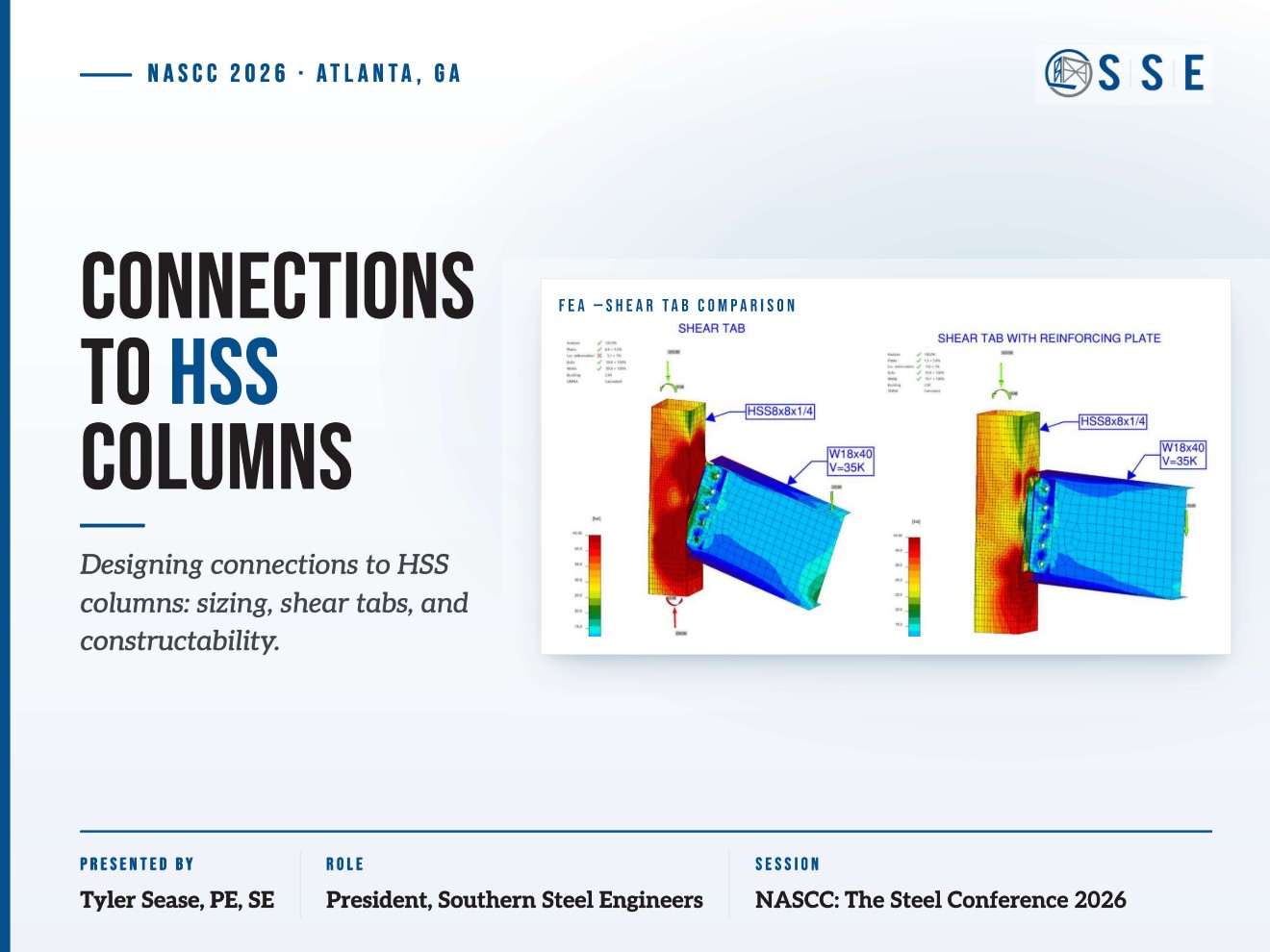
This article is based on a presentation Tyler Sease, PE, SE gave at NASCC: The Steel Conference 2026 in Atlanta. HSS columns are picked for good structural reasons, but the connections to them are where construction cost is won or lost. The decisions made early on column sizing ripple through fabrication, welding, and field installation, and the lightest column that satisfies the demand is rarely the cheapest column once the connections are designed and built.
We will cover this project in more depth in a future article. The connection involved an HSS6x6x5/8 column with moment connections framing in from multiple directions. The moment demand drove the design to through plates at each beam location, and by the time the assembly was complete, that one column had 13 CJP welds within a roughly 5-foot section. The cost of that connection assembly was not what the estimator priced when the column schedule was sized. Beyond the cost, the fit-up was difficult: the column was chopped into short pieces between through plates, and aligning those pieces straight in the shop took significant time and skilled labor before any of the CJP welds could be made.
The column itself satisfied the structural demand at minimum weight. The connections did not, and the shop paid for it in CJP welding hours and fit-up time. That gap between column-sizing economy and connection-fabrication reality is the central tension of HSS column design, and it is the reason this article exists.
HSS sections are an excellent choice in many situations and for good reasons:
Common applications include columns, braces, struts, pipe rack framing, screen walls, and truss members. The structural advantages are real. The constructability tradeoffs are also real, and they are what we want to focus on for the rest of this article.
HSS walls are thin and flexible compared to the flanges of a wide-flange shape. When a connection imposes out-of-plane loading on the face of an HSS column, the wall itself can deform before the connecting elements reach their capacity. AISC Design Guide 24, Hollow Structural Section Connections, illustrates this behavior clearly. It is the reason connection design to HSS columns is fundamentally different from connection design to wide-flange columns.
The practical consequence is that the lightest HSS section that satisfies the column demand is often not the section that should be specified. Reinforcement is costly. Specialty welds are costly. Through plates are very costly. The least column weight rarely produces the least project cost when connection fabrication is factored in. This is the kind of cost driver our engineering services for steel fabricators are built to flag early, before the column schedule locks in expensive downstream work.
Shear tabs are the most cost-effective beam-to-column connection for HSS columns. They use a single plate welded to the face of the column with a bolted connection to the beam web. There is no reinforcement, no through plate, and no specialty fabrication. For a shear tab to work without reinforcement, the HSS wall must be thick enough relative to its width to satisfy wall slenderness limits per AISC 360-22 Table B4.1a.
The following table summarizes the minimum HSS wall thickness required to accept a face-mounted shear tab without reinforcement, for square and rectangular HSS sections in A500 Grade C steel:
| HSS Width b (in) | Minimum Wall Thickness (in) |
|---|---|
| 4 | 3/16 |
| 5 | 3/16 |
| 6 | 3/16 |
| 8 | 1/4 |
| 10 | 5/16 |
| 12 | 3/8 |
| 14 | 1/2 |
| 16 | 1/2 |
| 18 | 5/8 |
| 20 | 5/8 |
If the specified HSS wall is thinner than the threshold above, a face-mounted shear tab is not viable without reinforcement, and the connection has to move to a more expensive alternative. This is the single most useful piece of information an engineer can carry into the column sizing exercise. We built a free HSS Column Slenderness Checker on the SSE Tools page to make this check fast for both engineers and fabricators.
When the HSS wall is too thin for a basic shear tab, the connection has to move to one of several alternatives. Each step away from a face-mounted shear tab adds shop labor, material, or both:
The cost progression matters. A column upsize that keeps the connection at a basic shear tab is often less expensive than the column saving that triggers reinforcement on every connection.
AISC 360-22 Chapter K introduces a chord stress interaction parameter (Qf) that reduces the available connection capacity when the HSS column itself is highly utilized. The intuition is that a column carrying significant axial load has less reserve capacity at the wall to resist additional out-of-plane connection forces. The relevant equations from Chapter K for longitudinal plate connections are:
One common point of confusion: U is a utilization ratio based on demand-to-capacity, not a stress ratio. Treating it as a stress ratio understates the capacity penalty.
The practical impact on connection capacity is significant. For a W18x40 framing into an HSS8x8x5/16 with a 5-row LRFD shear tab, the available connection capacity changes with column utilization as follows:
A column at 95 percent utilization gives up roughly 40 percent of its connection capacity before the connection itself is even checked. The lever in the other direction is wall thickness. For the same W18x40 framing into an HSS8x8 at U = 0.80 with a 5-row LRFD shear tab:
Going from a 1/4-inch wall to a 5/8-inch wall on the same HSS8x8 footprint multiplies connection capacity by roughly six. Engineers can use this as a sizing lever where heavy connections are anticipated. Fabricators can use it as the substance of the conversation to have early with the EOR when a connection package is going to be expensive at the as-specified column size.
Moment connections to HSS columns range from directly welded details for light moments to wraparound plate assemblies for heavier demand. The key constructability point is that when moment connections frame in on all four orthogonal sides of an HSS column, beam depths should be coordinated to align flanges as closely as possible. Aligning flanges allows a single set of stiffeners or wraparound plates to serve multiple connections, which significantly reduces fabrication and reinforcement.
This is one of the highest-leverage coordination items between the EOR and the connection engineer on HSS-framed lateral systems.
Welding to HSS introduces a few details that are different from welding to wide-flange shapes. Flare bevel groove welds are common at HSS corners, and the effective weld size depends on both the welding process and the HSS thickness, per AWS D1.1 Clause 10. Designers and detailers who do not account for the process-specific effective size will undersize these welds. Other considerations include shaped profile welding at branch-to-chord intersections, weld build-out at small-radius corners, and the use of backing where a complete-joint-penetration weld is required.
Bolting to HSS columns has its own considerations because the back face of the wall is generally inaccessible. The available options include:
The bolting alternatives are worth knowing because they unlock connections that would otherwise be impossible without site welding. Coordination with the steel detailer on these assemblies matters: bolt installation access, hole tolerances, and erection sequence all flow through to the shop floor. We work closely with detailers on HSS connection packages as part of our engineering services for steel detailers.
The references our team uses regularly when designing connections to HSS columns:
HSS column connections are a regular part of our steel connection design practice. Across that volume of work, the same patterns surface repeatedly: column sizing decisions made without considering connections, slenderness limits that force expensive alternatives, and Qf reductions that catch projects late. The free HSS Column Slenderness Checker on the SSE Tools page is one of the resources we built specifically to help engineers and fabricators catch these issues earlier. For a broader look at how delegated connection design projects succeed or stall, see our article on 3 Keys to a Successful Delegated Steel Connection Design Project.
This article is the cornerstone of a series. We will be following up with separate deep dives on the Atlanta Iconic Tower case study with round HSS columns and no through plates, sizing HSS columns for connection cost, and the Qf chord stress interaction parameter explained. If your next project includes connections to HSS columns, we are ready to support you. Reach out to us. This is where we thrive.